

Stone or woven: how a shade's material changes the light.
A pendant's material decides where its light goes. A solid travertine shade sends a focused pool of light downwards, while a woven shade lets light through and scatters soft, patterned shadow around the room. Here's how each one behaves, and which suits which space.
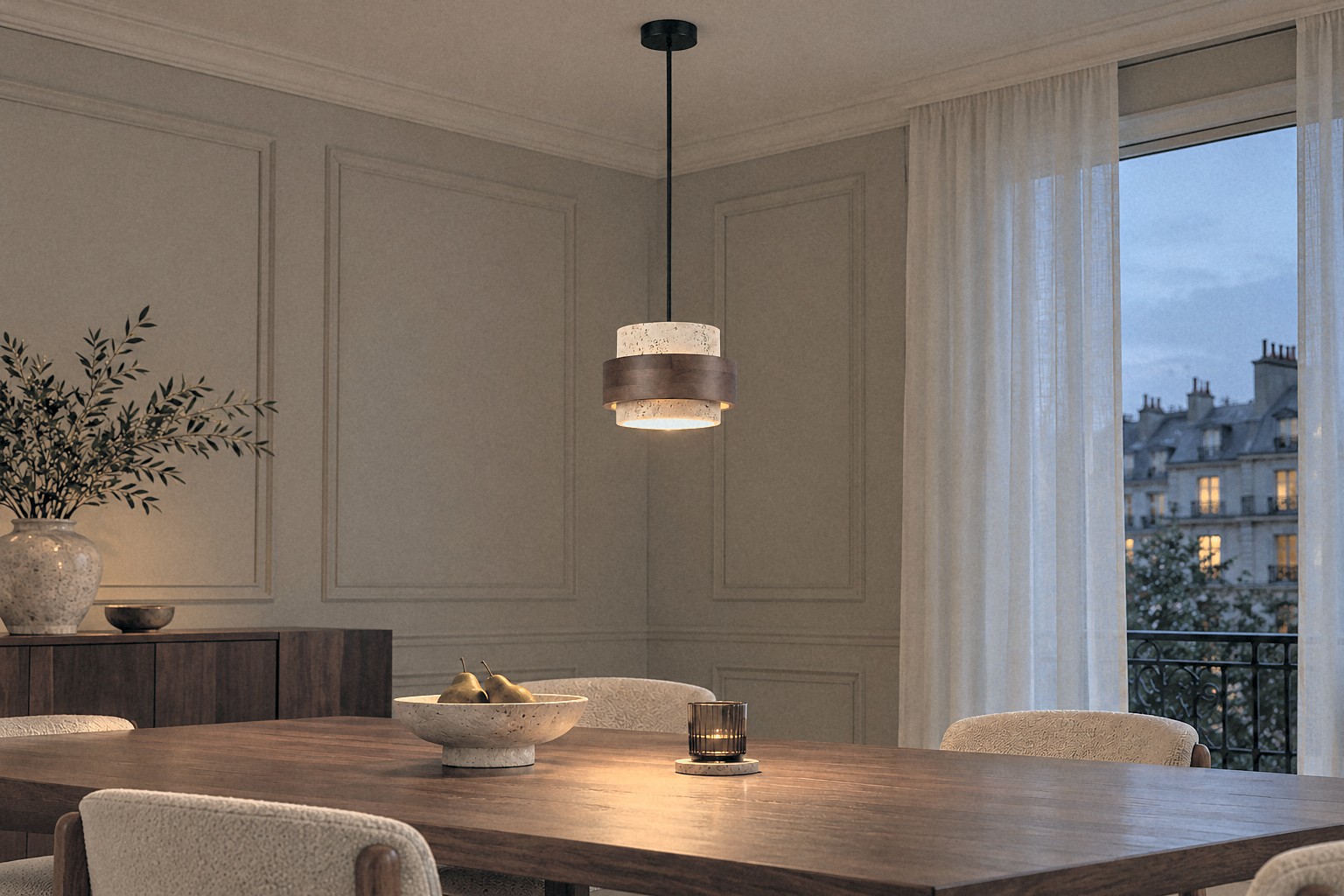
Travertine: light where you need it.
Travertine is opaque, so the stone itself doesn't glow. Light leaves through the open base of the shade and lands on the table, worktop or nightstand below. The result is a warm, defined pool of light with a soft edge, and a shade that reads as a calm, solid object above it.
That makes travertine a good choice over a kitchen island or dining table, where you want light on the surface and less glare at eye level. It works beside a bed too: a pair of slim stone pendants lights a book without lighting the whole room.
Woven shades: light that fills the room.
A woven shade works the other way. Light escapes through every gap in the weave, so the whole shade glows and throws a pattern of light and shadow onto nearby walls and the ceiling. A more open weave gives sharper, more dramatic shadows; a tighter weave softens the contrast, so the shade reads as one warm surface.
Woven pendants suit living rooms, bedrooms and dining areas where you want a relaxed, ambient glow rather than a task light. They're also light to look at, so a wider woven shade won't feel heavy in a smaller room.
Texture by day, light by night.
During the day, a lamp is mostly an object: you see its form, colour and texture. Travertine shows its pores and warm tone; a weave shows its rhythm and grain. After dark, the light it gives becomes the bigger part of the picture. Look at any light both on and off before you choose, because it should belong in the room in daylight too.
Which one for which room?
- Kitchen island: travertine, in a pair or trio, for focused light on the worktop.
- Dining table: a single larger stone shade such as the A823, or a woven cylinder for a softer, more social glow.
- Bedside: slim travertine pendants like the A809 keep the light on your book.
- Living room or hallway: a woven shade spreads light and pattern across the space.
Mixing stone and weave in one room.
You don't have to choose just one. A common pairing is travertine pendants over a kitchen island for task light, with a woven pendant over the dining table nearby for a softer glow. Keep one thing consistent to tie them together: a shared wood tone, a similar hanging height or the same warm-white bulb throughout. In a bedroom, slim stone pendants at the bedside sit well with a woven or faux-silk table lamp across the room, so each light has its own job and the room never feels over-lit.
Choosing the right bulb.
For both materials, a warm-white LED around 2700K brings out the honey tones of travertine and the natural colour of a weave. Very bright, cool-white bulbs tend to flatten texture. In a woven shade, a frosted bulb softens glare through the gaps; in a stone shade, choose a bulb that sits fully inside the shade so it isn't visible from the side.
Caring for each material.
Stone and weave need different care: travertine dislikes acids and water, while woven shades need gentle dusting and a dry room. Our care guide has step-by-step advice, and our materials guide explains each material in more detail.